Celtic Finery: Weaving Ancient Myth into Modern Design
There’s a specific kind of visual storytelling that only certain typefaces can achieve. It’s the feeling you get when you see a logo that feels rooted in history, or a book cover that seems to whisper of ancient legends and untold adventures. This is the power of a typeface with a story, one that carries the weight of tradition while still feeling fresh and purposeful. For designers and creators looking to inject a sense of heritage, craftsmanship, and mystical elegance into their work, the answer often lies in a font that bridges the past and the present.
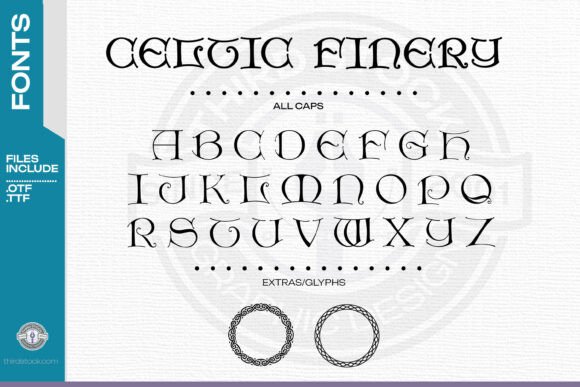
Enter Celtic Finery, a sophisticated all-caps decorative display typeface that does exactly that. It’s not just a collection of letters; it’s an invitation to step into a world of insular art and intricate knotwork. Inspired by the flowing lines of ancient manuscripts and the bold strokes of traditional calligraphy, this font manages to feel both timeless and remarkably clean. Its elegant, curved serifs and subtle flourishes are a direct homage to Celtic artistry, yet the overall design maintains a modern legibility that makes it surprisingly versatile.
A Typeface with a Story to Tell
What makes Celtic Finery visually appealing isn’t just its historical roots—it’s how those roots are translated into a functional design asset. The semi-distressed quality, inspired by a vintage 1960s poster, adds a layer of authenticity and texture. It feels handmade, not sterile, which is a crucial distinction for brands that want to convey warmth and character. The included Celtic circle dingbats are a thoughtful touch, allowing you to create cohesive decorative elements without hunting for separate graphics.
This typeface excels where storytelling is paramount. Think of a fantasy novel cover where the title needs to feel epic and otherworldly. Celtic Finery delivers that gravitas instantly. Consider a craft brewery’s label for an Irish stout or a meadery’s branding; the font’s connection to heritage and craftsmanship makes the product feel more authentic and premium. It’s a typeface that doesn’t just display words—it frames them within a narrative.
Practical Applications for the Modern Creator
The true value of a creative font like this lies in its adaptability across different projects. Its all-caps nature and strong silhouette make it ideal for headlines, logos, and any application where you need immediate visual impact.
- Brand Identity & Logo Design: For businesses rooted in history, craft, or fantasy—like artisan bakeries, historical societies, tabletop gaming companies, or heritage brands—Celtic Finery can form the cornerstone of a memorable logo. Pair it with a simple sans-serif for body text to create a balanced and professional brand system.
- Packaging & Labels: This is where the font truly shines. For specialty food products, craft beverages, or artisanal goods, it communicates quality, tradition, and care. Imagine it on a bottle of cold brew coffee or a jar of small-batch jam, paired with parchment textures or kraft paper.
- Print & Editorial Design: Use it for chapter headings in a fantasy anthology, the masthead of a niche magazine, or the title of a poster for a Renaissance fair. Its decorative nature commands attention without overwhelming the page.
- Digital & Social Media: While best used for headlines and titles on the web, it can make a website banner or a social media graphic for a historical event or fantasy podcast stand out. It’s perfect for creating eye-catching YouTube thumbnails or Instagram story highlights.
- Events & Merchandise: From wedding invitations with a Celtic theme to t-shirts for a folk music festival, the font adds a layer of thematic depth and perceived value.
Integrating Celtic Finery into Your Workflow
Adopting a new display font is more than just a stylistic choice; it’s a strategic decision that affects your project’s clarity and impact. Here’s how to use Celtic Finery effectively.
Font Pairing is Key. A decorative all-caps serif like Celtic Finery is a star player, but it needs a supporting cast. It pairs beautifully with clean, geometric sans-serif fonts for body copy. Think of it as the ornate headline and a font like Montserrat or Lato as the readable paragraph text. This contrast ensures your design is both visually interesting and easy to consume. Avoid pairing it with other highly decorative or script fonts, as they will compete for attention.
Context Matters. Match the font’s personality to your project’s goals. Using it for a law firm’s website would be a mismatch, but for a craft distillery’s menu, it’s perfect. Always consider your audience. Will they associate the style with the right values? For a fantasy gaming manual, the answer is a resounding yes.
Test for Readability. While designed for legibility, any all-caps display font requires careful handling. Use it at larger sizes for headings. Ensure there is adequate letter-spacing (tracking) so the letters don’t feel cramped. Test it in both color and black-and-white to see how the intricate details hold up.
Explore the Glyphs. Don’t overlook the included alternate characters and dingbats. These are not just extras; they are tools for customization. Using an alternate ‘A’ or ‘S’ can make a logo feel unique and tailor-made. The Celtic circles can be used as section dividers or decorative accents to create a fully integrated design language.
Beyond the Font: Building a Cohesive Visual Language
A typeface is a starting point. To maximize the impact of Celtic Finery, think about the ecosystem it lives in. The right supporting elements can elevate its effect.
Consider your color palette. Deep greens, rich golds, burgundies, and earthy tones complement its historical feel. Metallic accents like gold foil stamping on a print piece can lean into its royal, luxurious connotations. For digital projects, subtle gold or bronze gradients can achieve a similar effect.
Texture is another powerful ally. Pairing the font with a subtle parchment background, a linen texture, or even a slightly worn paper effect can enhance its vintage-inspired character and make your design feel more tactile and authentic. This is especially effective for packaging and print materials.
Finally, always be mindful of commercial licensing. If you’re using Celtic Finery for a client project, merchandise for sale, or any commercial venture, ensure you have the appropriate license. This protects you legally and supports the type designers who create these valuable assets. Using a premium font correctly is an investment in the professionalism and integrity of your work.
In the end, Celtic Finery is more than just a set of glyphs. It’s a bridge to a rich visual history, a tool for crafting stories, and a means to give your projects a distinctive voice that feels both ancient and authentically crafted. Whether you’re designing a brand identity from scratch or adding a finishing touch to a creative project, it offers a unique blend of mystical elegance and practical design sensibility.