Broken Through: A Typeface for Every Story You Want to Tell
There's a particular kind of frustration that comes with scrolling through font after font, searching for that one typeface that doesn't just fit your project but elevates it. You know the feeling—something that looks charming on screen but falls flat in print, or something that feels trendy today but will look dated in six months. Broken Through sidesteps all of that. It's a typeface built with real creative work in mind, the kind of font you reach for when you need something that feels both fresh and genuinely useful across a dozen different projects.
A Font That Actually Works the Way You Do
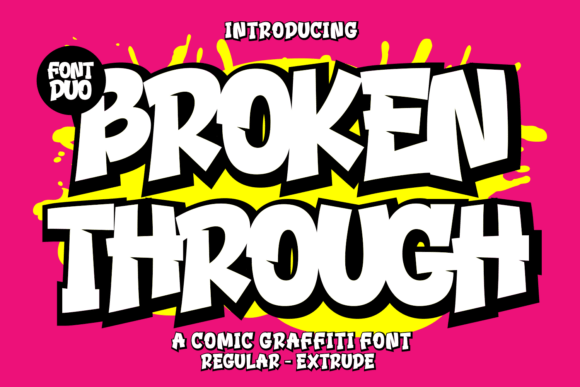
What makes Broken Through stand out isn't just its visual appeal—it's the sheer range of situations where it genuinely performs. This isn't a one-trick display font that looks gorgeous in a headline but crumbles the moment you try to use it at a smaller size or in a different context. The typeface carries elements of craft, street art, comic lettering, and accent styling, but it does so with a cohesion that keeps it from feeling scattered or confused.
Think about the last time you worked on a branding project. You needed something that could live on a business card and a billboard. Something that worked in a single color and full color. Something that felt personal without being unprofessional. Broken Through handles that kind of versatility with a quiet confidence. Its cursive elements add personality without sacrificing legibility, and its extrude style creates a subtle sense of depth that gives flat designs a three-dimensional quality.
For small business owners especially, this matters. You're not hiring a different designer for every touchpoint. You need a typeface that holds its own across your website headers, your Instagram stories, your product packaging, and your printed invoices. Broken Through does that work without requiring you to become a typography expert in the process.
Where It Really Shines: Practical Applications
Let's talk specifics, because vague promises about "versatile fonts" don't help anyone make a decision.
Social media and digital content are where Broken Through immediately feels at home. The font was designed with these platforms in mind, which means it renders cleanly at the sizes and resolutions where most people will actually encounter it. If you're creating quote graphics for Instagram, designing Pinterest pins, or building out story templates, the typeface gives you that eye-catching quality without looking like you're trying too hard. Its charm is approachable rather than intimidating.
Merchandise and apparel design is another natural fit. T-shirt typography is deceptively difficult—what looks great on a 27-inch monitor often becomes illegible or awkward when printed on fabric. Broken Through's clean lines and balanced letter spacing translate well to physical products. Whether you're designing for a print-on-demand shop or creating custom pieces for a local market, the font maintains its character across different printing methods, including sublimation.
Packaging and product labels benefit from the typeface's ability to feel both artisanal and polished. If you're selling handmade candles, specialty foods, or boutique cosmetics, Broken Through gives your packaging a crafted feel that signals quality without the stiffness of traditional serif fonts. It photographs well too, which matters enormously when your product's first impression happens on someone's phone screen.
Editorial and publishing work might seem like an unusual match for a font with such playful energy, but Broken Through pulls it off. Book covers, magazine features, blog headers, and digital publications all benefit from typefaces that grab attention while remaining readable. The font works particularly well for lifestyle, food, travel, and creative industry content where a warm, human tone matters more than corporate formality.
Making Typography Work for Your Brand
Choosing a font for a brand identity project is fundamentally different from choosing one for a single design. You're not just asking "does this look good?" You're asking "can I build an entire visual language around this?" That's a much harder question, and it's where many creative fonts fall short.
Broken Through handles this challenge by offering enough variety within its family to create visual hierarchy without losing consistency. You can use its bolder, extruded styles for headlines and its cleaner weights for supporting text, all while maintaining a unified look. This is especially valuable for entrepreneurs building brand identities on tight budgets—you get the range of a professional type system without the complexity or cost.
When you're pairing Broken Through with other fonts, look for clean sans serifs or simple serif companions that don't compete for attention. The typeface has enough personality to anchor a design, so your supporting fonts should play a quieter role. Think of it like styling an outfit—Broken Through is the statement piece, and everything else should complement rather than clash.
A Few Honest Considerations
No font is perfect for every situation, and it's worth knowing where Broken Through works best and where you might want to reach for something else.
Readability at very small sizes is something to test carefully. Like most display and script-influenced fonts, Broken Through performs best at medium to large sizes. For body text in long-form articles or dense product descriptions, you'll want to pair it with a more conventional body font. This isn't a weakness—it's simply a matter of using the right tool for the right job.
Licensing matters if you're using the font commercially. Before you commit to Broken Through for a client project or a product line, make sure you understand what the license covers. Most premium font licenses are straightforward, but it's worth confirming that your intended use—whether that's merchandise, digital products, or client work—is included. This small step protects you and ensures you're using the typeface ethically.
Testing across platforms is something many people skip, and it's a mistake. Before you finalize any design using Broken Through, check how it looks on different devices, in different browsers, and at different sizes. A font that looks perfect in your design software might render slightly differently in a web browser or when printed on a specific material. A few minutes of testing can save you from unpleasant surprises down the line.
The Multilingual Advantage
One feature that deserves more attention than it typically gets is Broken Through's multilingual support. If your audience extends beyond English-speaking markets—or if you're creating content for a diverse, multilingual community—this matters more than you might initially think. Having a font that handles accented characters, special punctuation, and non-Latin scripts gracefully means you can maintain visual consistency across all of your communications without resorting to mismatched fallback fonts.
For global brands, international bloggers, or anyone working with multilingual content, this kind of built-in support is a genuine time-saver and a quality safeguard. It means your French product descriptions look just as polished as your English ones, and your Spanish social media posts carry the same visual weight as your Italian ones.
Why It's Worth Your Attention
The best creative tools are the ones that get out of your way and let you focus on the work itself. Broken Through doesn't demand that you redesign your entire approach to typography—it simply gives you a reliable, attractive option that performs across a wide range of real-world applications. Whether you're a designer building out a client's brand system, a crafter creating seasonal greeting cards, or a content creator looking for a font that makes your quotes and graphics pop, it's the kind of typeface that earns its place in your toolkit through consistent, dependable results.
That's the real value of a font like this. It's not about chasing trends or making bold typographic statements for their own sake. It's about having something you can trust to look good, work well, and adapt to whatever project comes next. And in a creative landscape where the tools are always changing, that kind of reliability is worth more than any single aesthetic choice.